
What every employer needs to ascertain: who creates value with AI, and who can be trusted with it.
The SIAA Standard tests both on real work from each person's own job, with a live AI on screen. Every result shows what the person achieved with the AI. It also shows whether they kept data safe, caught its mistakes and handed over work others can rely on.
- Six competenciesthree for value, three for risk
- Live AIon screen for every task
- 163 professions96 work skills, 20 industries
- Three certificatesProficient, Advanced, Expert
Most AI skills tests never let the candidate use AI.
In October 2026 we checked 21 AI skills tests and credentials. 15 are multiple-choice exams, course badges, self-ratings or counts of tool use. These show what a person knows about AI, but not how they work with it. The other 6 put an AI on screen, but none tests what a person does when the AI is wrong.
| Kind of test | The candidate works with a live AI | Tests what people do when the AI is wrong | Tests whether colleagues can rely on the work handed over | Assesses the thinking behind the answer | Supervised certificate at three levels |
|---|---|---|---|---|---|
| Course badgesWatch lessons, pass a short quiz | No | No | No | No | No |
| Knowledge examsMultiple-choice questions about AI | No | No | No | No | One level |
| Self-ratings and profilesPersonality, reasoning, self-report, tool use | No | No | No | No | No |
| Hands-on AI tasksAn AI tool on a work-like task | Yes | No | No | Some | No |
| The SIAA Standard | Yes | Yes | Yes | Yes | Yes |
SIAA market scan of AI skills credentials and assessments, October 2026, from what each provider publishes.
We test what people do when the AI is wrong.
The AI on screen is a real AI, answering live. Every candidate gets the same AI, with the same short instructions that give no hints. In Reliability questions, the page adds two or three planted errors to the AI's draft, of the kind AI models really make. We mark whether the candidate catches them before the work goes out. In every question, we assess the thinking behind the answer: what they gave the AI, what they checked and what they sent.
From a test · refunds report
Total refunds for the quarter come to $184,600, up 9% on the second quarter.
That total doesn't match your table. Row 7 (City Mall store) is counted twice. Please add the rows again and show the sum.
You're right. Without the repeated row the total is $172,200, up 2%.
Caught the planted error: the AI's total was $12,400 too high. Checked it against the table before using it.
Candidate Screening Test
Know who to interview, and what to ask them.
Every candidate for a role sits the same 30-minute test, written for your role, industry and work skills. You get a report on each one. It says whether they are likely to meet the Proficient standard, shows the evidence from their own work, and gives questions to ask at interview.
- About 30 minutes
- Built for your role
- You read every question first
This test helps you choose who to interview. It does not give a certificate. A named person in your team reviews every result before any candidate is turned down.
Candidate C
Likely below Proficient
Candidate A
Likely Proficient or above
Sample report
Candidate B
Claims executive · Insurance
Likely Proficient or above
- AccelerationMet
- SafetyMet
- ReliabilityMet
- HandoverMet
Checked the AI's figure for the policy excess against the policy wording, and corrected it before replying to the customer.
"How did you decide which of the AI's figures to check before you replied?"
Workforce Assessment
See where your people stand. Then prove the training worked.
Each person sits a 60-minute test on their own kind of work. You see results for every person, team and department in the six competencies. You see who puts work or data at risk, and which training closes each gap. Test again after training to measure the change.
- About 60 minutes
- Staff, civil servants, students
- Results by department, agency or college
SIAA Standard Certificate
Proof of a level that any employer can check.
There are three levels. Each has its own test of real work with a live AI, harder at each level. Safety, Reliability and Handover are required at every level. Advanced and Expert add Expansion and Delegation.
Proficient
Trusted with AI on routine work: faster, just as good, and safe.
Advanced
Trusted on complex work and work outside their field. Oversees AI agents.
Expert
Makes AI safe and useful for others. Designs how people and AI agents share the work.
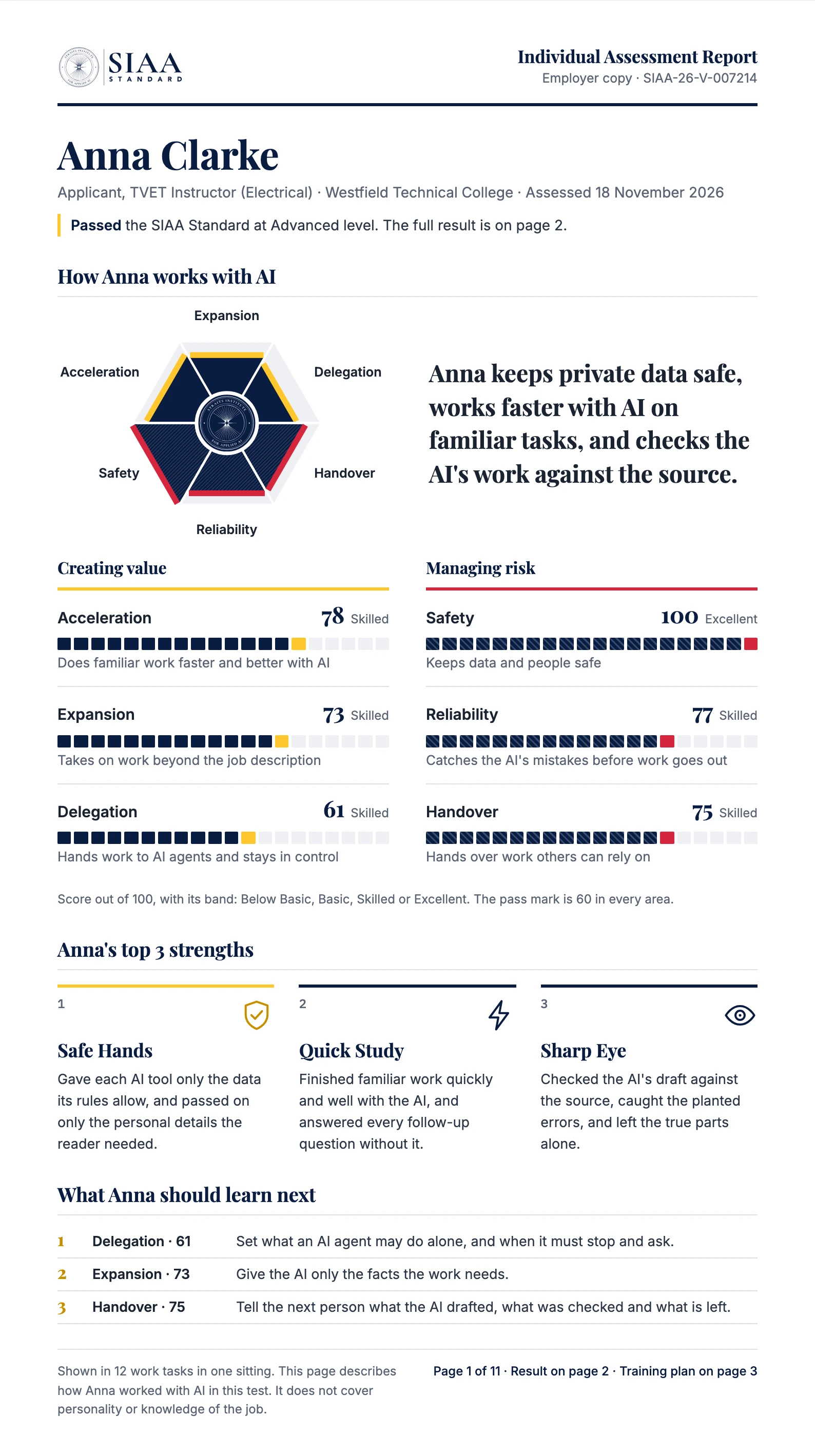
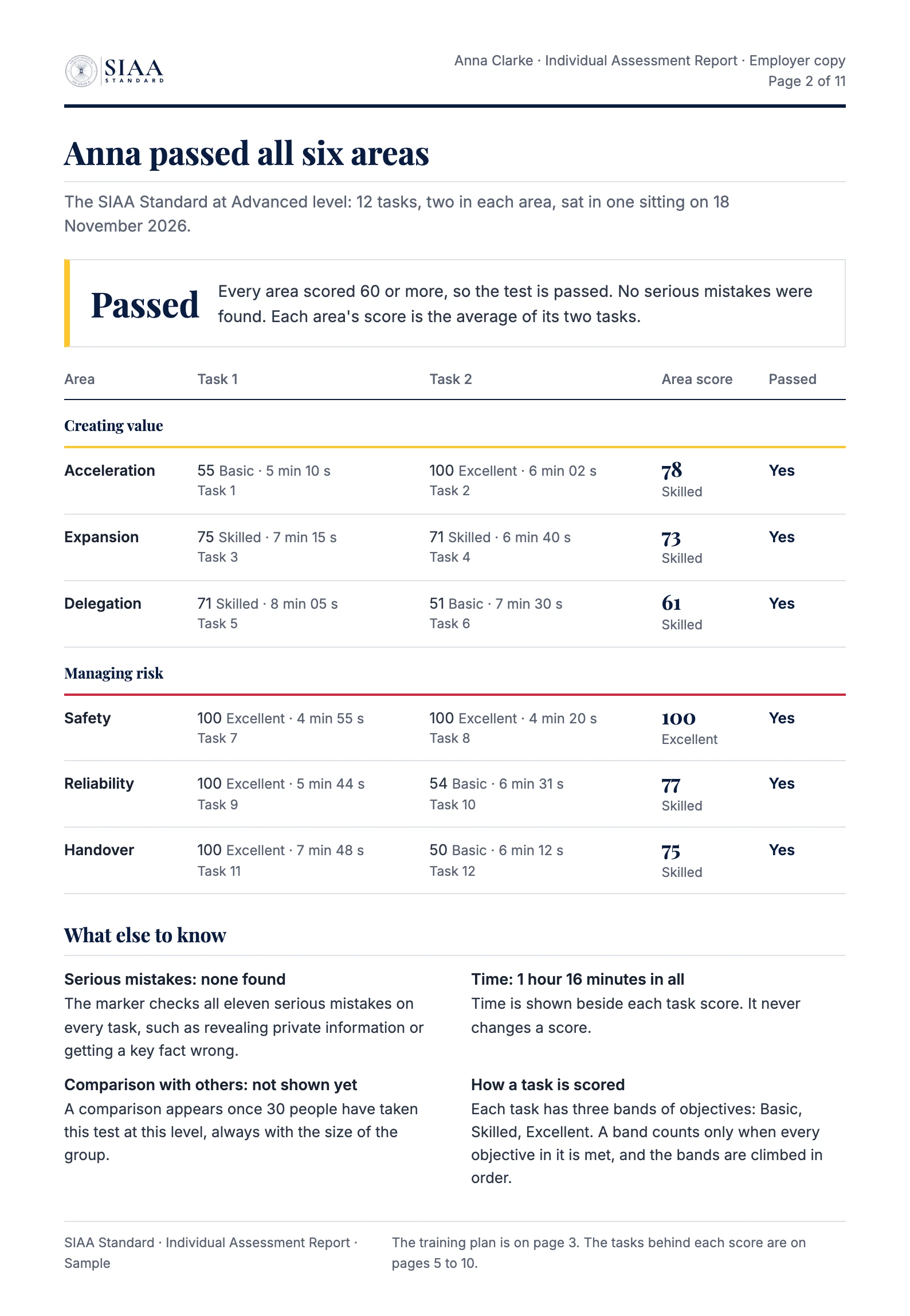
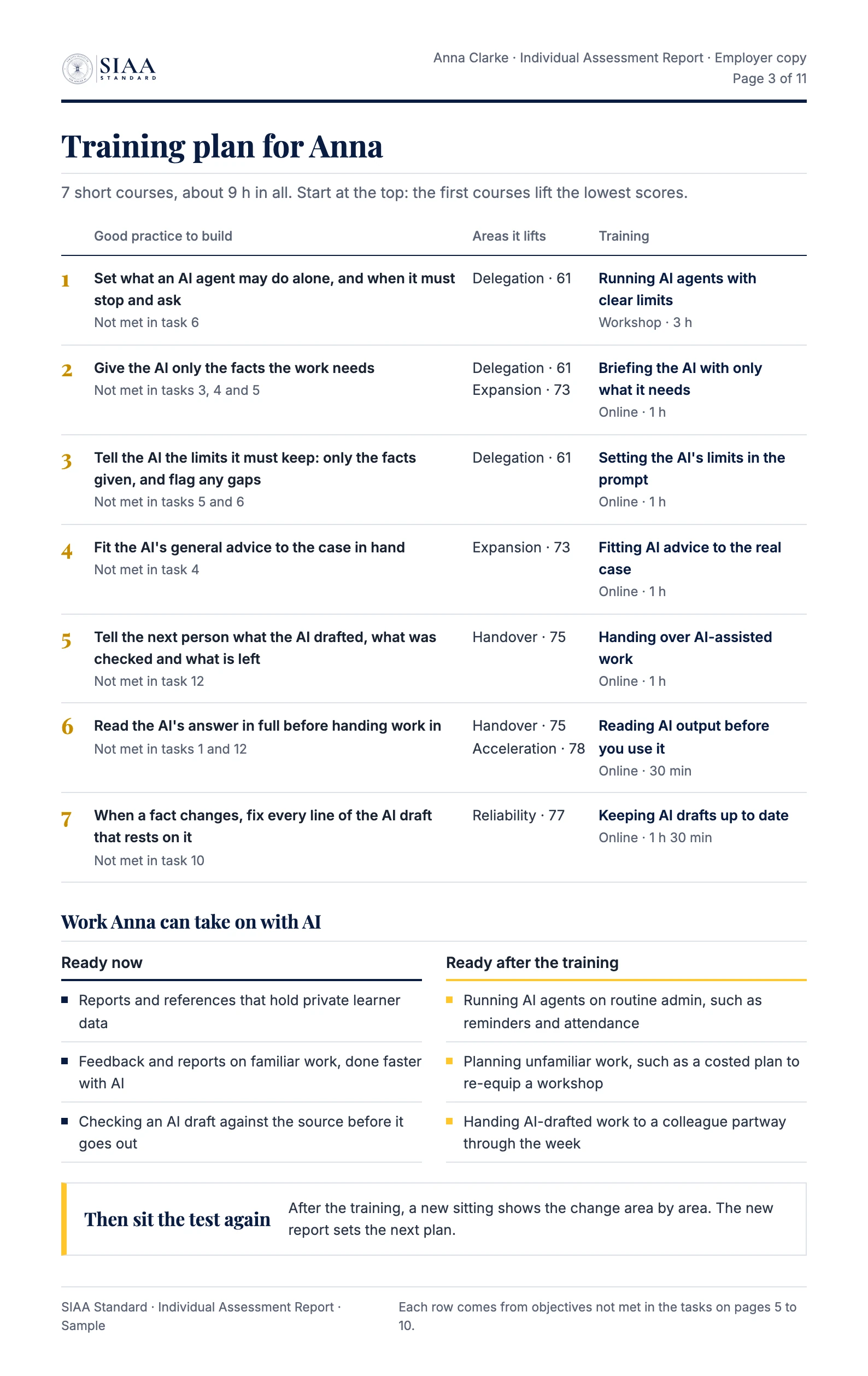
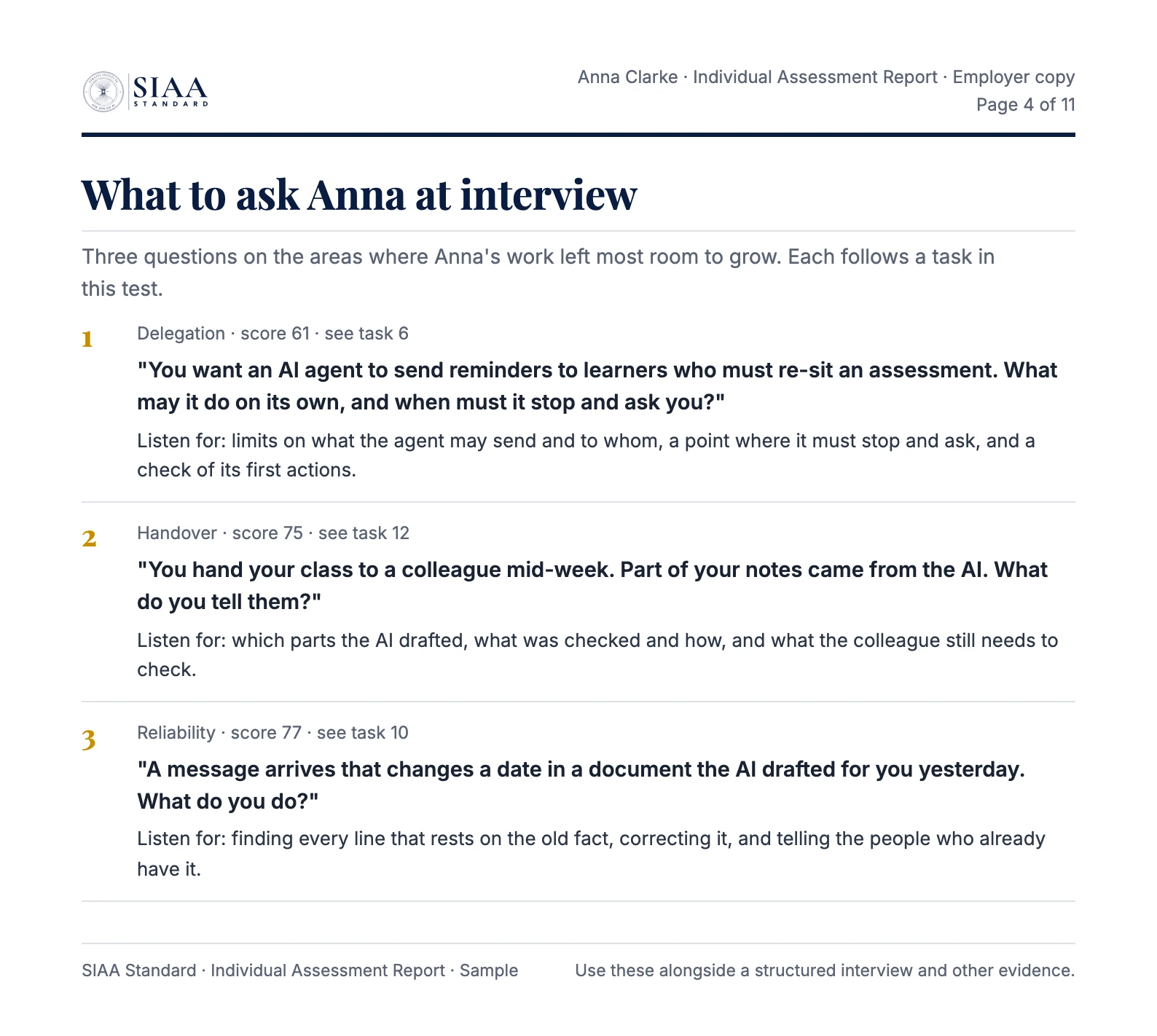
Every sitting comes with a full report.
Four of its eleven pages, from a sample report.
A pilot takes about eight weeks.
Start with one team, one group of students or one agency. You see the test working with your own people before you decide on more.
- Week 1We agree the roles to test and the people taking part. You name one contact person.
- Weeks 2 to 3We write the tests for your roles. You can read every question before it is sent.
- Weeks 4 to 6Your people sit the tests online, at a time that suits them.
- Week 7Results in your console, person by person and by team.
- Week 8A pilot report and a debrief: what the results show, where the gaps are, and what training would close them.
Built on published research, held to published targets.
Our method is set out in a paper by Seng Beng Ho, CH Peh, Roger Simões, Shawn Chia, Elijah Ng and Jennifer Dodgson: Measuring the Human Contribution When AI Is Allowed.
- 85%of pass-or-fail decisions must come out the same on a second sitting; 90% for a certificate.
- Every hiring useA named person reviews the result before any candidate is turned down.
- Every versionChecked for fairness by gender, age, first language and job family.
Start with a pilot in one team.
Talk to usContact
Get in touch.
Tell us about your organisation and what you want to measure. We will reply to discuss a pilot.
- ✓Employers: test new hires and current staff
- ✓Universities and colleges: grade and certify students
- ✓Governments: measure and train the public service